



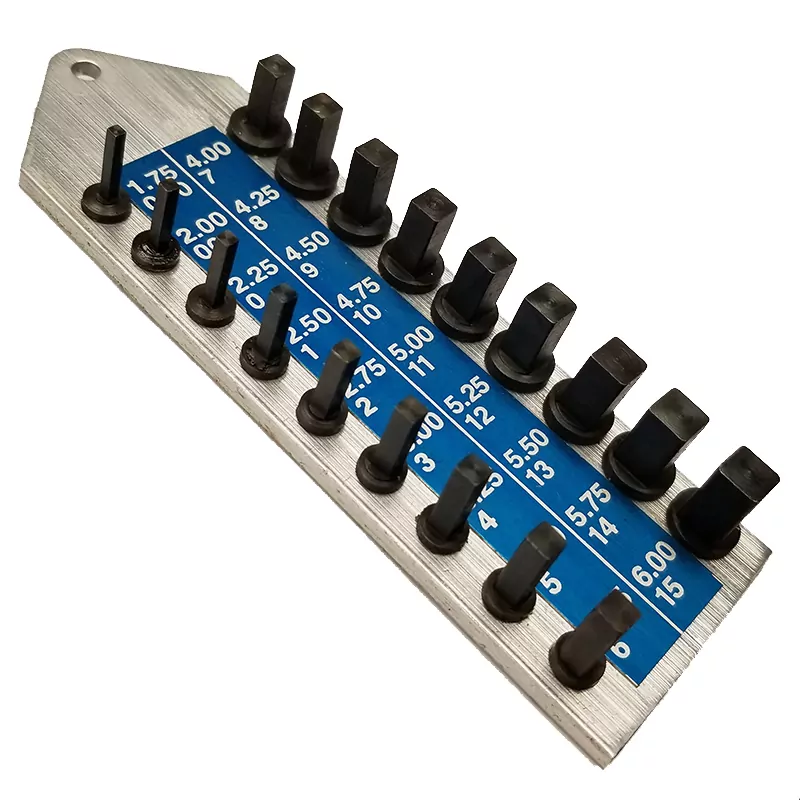


Clock Key Size Gauge
$37.00
Clock Key Size Gauge
A pile of unmarked clock keys may pile up in a mans lifetime. Not all the keys will be marked as to what size they are. This is a useful tool in this situation, it will let one know what the size clock key it is.
$37.00
In stock
SKU: CK13
Categories: All Products, All Clock Parts, Clock Keys and Cranks
Ships From: USA
Sold By: Clockworks Inc.
Returns: 30-day return policy
Secure Payment: Shop with confidence
Clock Keys and Cranks- Use our clock key chart to figure out the exact fit for the clock. We offer keys and grandfather clock cranks.
Please view these information tabs to help with determining the proper key size for your clock.
Mechanical Clock Keys
Mechanical clock keys are the clock parts that are most frequently lost. Once the clock key is no longer with the clock, it always seems to disappear. With the below information you can order a new key utilizing the clock key size chart.
Getting the Right One
We have mechanical clock keys in all the sizes available. Between the key chart or the movement type information below, you have a good chance of finding the perfect key. The movement type includes if the clock is made in Germany or USA and when it was made.
This is the fastest and most easiest way to get the clock key. The further back in time we go with clocks, the more we would need to rely on the key chart instead. There will be a stamp with the country of origin on the back plate of the movement and this can help us get the key.
Clock Key Size Chart Explanation
- 1.75mm = 000 Key
- 2.0mm = 00 Key
- 2.25mm = 0 Key
- 2.5mm = 1 Key
- 2.75mm = 2 Key
- 3.0mm = 3 Key
- 3.25mm = 4 Key
- 3.5mm = 5 Key
- 3.75mm = 6 Key
- 4.0mm = 7 Key
- 4.25mm = 8 Key
- 4.5mm = 9 Key
- 4.75mm = 10 Key
- 5.00mm = 11 Key
- 5.25mm = 12 Key
- 5.5mm = 13 Key
- 5.75mm = 14 Key
- 6.0mm = 15 Key
Clock keys have there own number system from 000 to 16 as seen in the Clock key size chart. However the number does not indicate what size is what number and can be confusing. So how do you use the Clock key size chart to get the right key?
It would make more sense if the key size was the MM of how wide the key was to fit, but this is not how it works. This section is to figure out what key number to order so the clock can be wound up. Subsequently, the clock key gets lost the most out of any other clock part.
Of course, it can be tricky to find the right key for your clock because there are many sizes. The Clock key size chart will give us the right size key to order.
Double End Clock Keys
In addition, some keys have two sizes on one key and this is called a double end key. By and large, the clock key size chart will work for both the wind up part of the clock and also the smaller F / S portion. When the clock has a F / S regulator portion it will be at the 12 o’clock on the dial.
Alternately, if there is a small arbor inside of a hole at 12, this is the time regulator control and the key would have two ends. Thus, it may say F / S at this location or A / R. F / S stands for Fast or Slow, or it could say A / R to stand for Advance or Retard and is referring to the timing of the clock.
Of course, if the clock is running fast in time, turn more to the Slow or Retard direction to slow it down. Refer to the Clock key size chart with your measurements to find a key to work with this function.
Getting the Right Clock Key Size
Given these points, to get the key needed, measure the shaft the key is to go on to, then use the Clock key size chart to get the key size needed.
Please do not call asking what key the clock needs, as you will be told it would still have to be measured. In short, measure the shaft that the key goes onto in MM and then use the clock key size chart to match it up.
The Lazy Way Instead of the Clock Key Size Chart
The Clock key size chart has all of the sizes listed however sometimes certain key sizes are known. Generally speaking, almost all post 1960 mechanical clocks, made in Germany take a size #8 key or crank, unless the movement is round.
Ordinarily the round ones take a number 4. The American time strike antique units mostly take the size 7 key. Match your measurements to the Clock key size chart to be sure.
How to find the Right Key for Hermle Movements

Clock Key Required by Hermle Movement Number
Use this Clock Key Chart to quickly identify the correct key number and type based on your Hermle movement ID number. Ensure a perfect fit for winding your clock!
Keys for German Units Post WW2
German made post WW2 movements that are square or rectangle will take a number 8 key or crank.
If the clock movement is round and made in Germany the key size is number 4. Some round ones will take a number 3 but if getting a 4 it will still fit and wind the clock either way.
Keys for USA Units 1900 – 1950
American clocks made from around 1875 until after the second war almost always take the size 7 clock key. The number 7 keys fits the 8 day time / strike units pretty much every time and this is what USA made the most of. This rule may not apply to Westminster (3 places to wind) or time only (one place to wind) clock movements.
Keys for Korean and Chinese Clocks
Size 7 for these units usually. All the 31 day clocks with Asian movements and also US replicas made in India, all take size 7.
The Over Wound Myth
Of course, if a clock is not working, people wind it up all the way in attempts to make it run. Everyone winds it up, but the clock still doesn’t work, so it remains wound up.
The only way a clock can be overwound is if someone winds it up for so long that the mainspring becomes stuck.
How Do I Know What Size My Clock Key Is?
Understanding the correct size of your clock key is crucial for maintaining and operating your timepiece. The key size affects how well you can wind the clock and keep it running smoothly. If you’re unsure about your clock key size, this guide will help you determine the right one and ensure your clock remains in good working order.
1. Why Is Knowing Your Clock Key Size Important?
Understanding the size of your clock key is essential for several reasons. First and foremost, the right key ensures that you can wind your clock efficiently. If the key is too small, it won’t grip the winding arbor correctly, making it challenging to wind the clock. Conversely, a key that is too large may slip, potentially damaging the clock’s mechanism. Therefore, knowing your clock key size prevents unnecessary wear and tear on your clock and ensures accurate winding.
2. How Are Clock Key Sizes Measured?
Clock keys are typically measured using a standardized numbering system. This system ranges from small to large, with each size corresponding to a specific measurement in millimeters. The size is determined by the diameter of the clock’s winding arbor, which is the part of the clock where the key fits. For instance, a size 6 key fits a winding arbor with a diameter of 3.75 millimeters. By measuring the arbor, you can accurately determine the correct key size.
3. What Tools Do I Need to Measure My Clock Key Size?
To measure your clock key size, you will need a few simple tools. A caliper or a precise ruler is ideal for measuring the diameter of the winding arbor. Additionally, you may use a clock key gauge, a tool designed specifically to measure clock key sizes. By using these tools, you can determine the exact size of your winding arbor, ensuring that you select the correct key.
4. Step-by-Step Guide to Measuring Your Clock Key Size
Determining your clock key size involves a straightforward process. Here’s how you can do it:
- Locate the Winding Arbor: First, identify the winding arbor on your clock. This is usually found on the clock’s face, where the key is inserted for winding.
- Measure the Arbor’s Diameter: Using a caliper, carefully measure the diameter of the arbor. Ensure the caliper is placed accurately to avoid any errors in measurement.
- Consult the Key Size Chart: Once you have the measurement, consult a clock key size chart. Match your measurement with the corresponding key size. For example, if your arbor measures 3.75 millimeters, you’ll need a size 6 key.
- Test the Key: If possible, test a key of the determined size on your clock. It should fit snugly, with no slipping or difficulty in turning.
5. What If I Don’t Have the Original Key?
If you’ve lost the original key or never had one, don’t worry. You can still find the correct size. Measure the winding arbor as described above and use the measurement to select a new key. It’s important to get the size right the first time to avoid damaging your clock.
6. Where Can I Purchase the Correct Clock Key?
Once you’ve determined the correct size, you’ll need to purchase a replacement key. At Clockworks.com, we offer a wide range of clock keys in various sizes to suit different types of clocks. Whether you need a standard size or a specialty key, you can find it in our catalog. Simply visit our website, navigate to the clock keys section, and select the size you need. We provide detailed descriptions and specifications for each key, making it easy for you to find the perfect match.

7. How Can I Ensure Longevity and Proper Maintenance of My Clock Key?
Proper maintenance of your clock key is as important as knowing its size. After every use, ensure that the key is stored in a dry place to prevent rust. Additionally, avoid using excessive force when winding your clock, as this can wear down the key and the winding arbor. Regular maintenance of both the clock and the key will ensure they last for years to come.
8. Are There Different Types of Clock Keys?
Yes, there are several types of clock keys, and each serves a different purpose. The most common are double-ended keys, which have different sizes on each end for winding and setting the time. Some clocks, especially antique ones, may require specialized keys. It’s essential to identify the type of key your clock requires before making a purchase. At Clockworks.com, we offer a variety of key types to match your specific needs.
9. What Should I Do If My Clock Key Doesn’t Fit Properly?
If you find that the key doesn’t fit properly, it could be due to several reasons. First, recheck the arbor’s diameter to ensure you’ve measured correctly. If the measurement is correct and the key still doesn’t fit, there may be an issue with the clock’s winding mechanism. In such cases, it’s best to consult with a clock repair expert. At Clockworks, we not only sell parts but also offer clock repair services. You can contact us at [email protected] for assistance.
10. Final Thoughts
Knowing the size of your clock key is fundamental to the proper functioning and maintenance of your timepiece. By following the steps outlined above, you can easily determine the correct key size and avoid potential damage to your clock. For a wide selection of clock keys and expert advice, visit Clockworks.com. We’re here to help you keep your clock ticking smoothly.

Double-End Clock-Key F-S Note
The following is a Double-End Clock-Key F-S Note that will be very handy. Some clocks have a small place that looks like a mini clock winding arbor at the 12. It may say F/S or A/R. The F/S represents fast or slow, and the A/R represents advance or retard.
This controls the timing of the clock and turning it to fast or advance makes time faster and the opposite for slow. An ideal double end key fits both the winding arbor to wind the clock and also fits the smaller time regulator aspect.
This is not easy to get and at the same time is the most lost part. It is possible to regulate the clock another way with an adjustable bob instead of a fixed length bob.
Get the double end key the hard way
Using the clock key size chart, get the right size that the clock requires. This chart works for both the fast/slow regulator and also to wind the clock.
However, this is not easy because it requires a measurement of the post the double end key fits onto. In order to get this measurement remove the clock movement or the dial. Without access to the front of the movement it is hard to measure exactly how wide the arbors are that the key is to go on.
Double end clock key the easy way
There are many sizes and combinations for the double end key and it may be tricky to get the right size. Sometimes it is best to just get the 4 pack of double end keys we offer
. These are the top 4 most common double end clock keys so the odds are one will be the correct key. Ideally this will supply the clock with a key that fits both the F/S regulator and the winders. However be aware this 4 pack does not guarantee one will work.
Double-End Clock Key F-S Note Continued – An alternate method
It is possible to forget the whole double end key game and use a single end key instead. It does make things easier and is a better long term solution.
Inevitably, once the perfect fit the key will get lost again. This seems to be the trend of what happens. Once the key is separate from the clock, there is a higher chance of it getting lost. Many times we suggest putting the key in the bottom of the clock case for safe keeping
Using an adjustable bob instead
The solution to the double end key problems is to get the single end key to wind the clock. Also get the adjustable bob. The adjustable bob can be regulate the clock with the pendulum instead.
The bob will have a nut on the bottom. Raise the bob on the pendulum to speed up time. The opposite is true for slowing time down. Once regulating the clock, it will stay this way for the most part. Some timing may or may not need to be done when the temperature changes vastly.
For the most part, time the clock and it will stay that way within a couple of minutes a day all year long. The adjustable pendulum bob comes in three sizes, or bob diameters. The middle or smaller diameter bob is fine for most clocks because the weight is not as important as the length.
Parts available to purchase
Other parts to consider besides the double end clock keys. We have two styles of the adjustable pendulum bobs. One of them is the three sizes of bobs that have the nut underneath. We call this the Adjustable Mantle Clock Bob.
There is another style bob that is adjustable from the back side. We just call it the Adjustable Antique Style Mantle Clock Bob. They both function the same, it has a bob on the pendulum that can regulate the time.
The part they hang onto is usually a long wire with flex spring steel on the top. This gets bent and cut into shape for the proper length. It comes in a three pack and we call them the Long Suspension Spring Rods.
Clock Key Size Chart Explanation
- 1.75mm = 000 Key
- 2.0mm = 00 Key
- 2.25mm = 0 Key
- 2.5mm = 1 Key
- 2.75mm = 2 Key
- 3.0mm = 3 Key
- 3.25mm = 4 Key
- 3.5mm = 5 Key
- 3.75mm = 6 Key
- 4.0mm = 7 Key
- 4.25mm = 8 Key
- 4.5mm = 9 Key
- 4.75mm = 10 Key
- 5.00mm = 11 Key
- 5.25mm = 12 Key
- 5.5mm = 13 Key
- 5.75mm = 14 Key
- 6.0mm = 15 Key
Clock keys have there own number system from 000 to 16 as seen in the Clock key size chart. However the number does not indicate what size is what number and can be confusing. So how do you use the Clock key size chart to get the right key?
It would make more sense if the key size was the MM of how wide the key was to fit, but this is not how it works. This section is to figure out what key number to order so the clock can be wound up. Subsequently, the clock key gets lost the most out of any other clock part.
Of course, it can be tricky to find the right key for your clock because there are many sizes. The Clock key size chart will give us the right size key to order.
Double End Clock Keys
In addition, some keys have two sizes on one key and this is called a double end key. By and large, the clock key size chart will work for both the wind up part of the clock and also the smaller F / S portion. When the clock has a F / S regulator portion it will be at the 12 o’clock on the dial.
Alternately, if there is a small arbor inside of a hole at 12, this is the time regulator control and the key would have two ends. Thus, it may say F / S at this location or A / R. F / S stands for Fast or Slow, or it could say A / R to stand for Advance or Retard and is referring to the timing of the clock.
Of course, if the clock is running fast in time, turn more to the Slow or Retard direction to slow it down. Refer to the Clock key size chart with your measurements to find a key to work with this function.
Getting the Right Clock Key Size
Given these points, to get the key needed, measure the shaft the key is to go on to, then use the Clock key size chart to get the key size needed.
Please do not call asking what key the clock needs, as you will be told it would still have to be measured. In short, measure the shaft that the key goes onto in MM and then use the clock key size chart to match it up.
The Lazy Way Instead of the Clock Key Size Chart
The Clock key size chart has all of the sizes listed however sometimes certain key sizes are known. Generally speaking, almost all post 1960 mechanical clocks, made in Germany take a size #8 key or crank, unless the movement is round.
Ordinarily the round ones take a number 4. The American time strike antique units mostly take the size 7 key. Match your measurements to the Clock key size chart to be sure.
Clock Key Size Gauge
A pile of unmarked clock keys may pile up in a mans lifetime. Not all the keys will be marked as to what size they are. This is a useful tool in this situation, it will let one know what the size clock key it is. It could also be used if someone were to measure how wide the winding arbor is, then compare to the tool. It will then let the person know what size key to order.
| Weight | 0.25 lbs |
|---|---|
| Dimensions | 1 × 2 × 4 in |
Related Articles
You may also like…

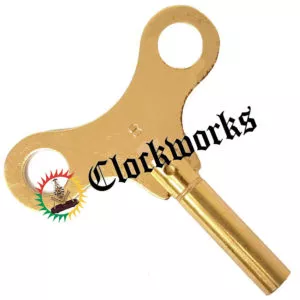
Clock Key Brass Single-End

French Style Clock Key

I have the opposite problem and about speed adjustment keys, rather than clock winding keys. I have a Gilbert, a Howard Miller, and a Seth Thomas. I have a set of clock key bits and was able to use that to identify the clock key size for each (only one the Seth Thomas came with a key). However the clock key bit set that you and other sell (one handle, box of bits) doesn’t have small outer diameter bits for checking F/S key sizes. Is there a similar set that contains narrow bits that will fit into the adjuster holes so that I can identify those?
Sorry not at this time
James Stoudenmire
30yr Clockmaker
Author of Clockworks.com
Nice, just what I was looking for!