



Mechanical Clock Spade Hands
Price range: $20.00 through $25.00
Mechanical Clock Spade Hands
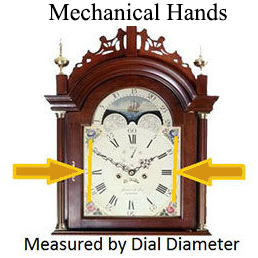
Spade hands that fit most German mechanical clock movements. Measure the hands by the time track diameter. A time track is the small ring outside of the numerals. The minute hand length will be about half this diameter.
Price range: $20.00 through $25.00
SKU: CH1
Categories: All Products, All Clock Parts, Clock Hands, Mechanical Clock Hands, German Mechanical Clock Hands
Ships From: USA
Sold By: Clockworks Inc.
Returns: 30-day return policy
Secure Payment: Shop with confidence
Mechanical Clock Hands are the arms that point to the numbers 1 to 12 so you know what time of day it is. Clock hands come in a variety of lengths.
Please view these information tabs to help get Mechanical Clock Hands.
Removing Mechanical Clock Hands
Removing Mechanical Clock Hands is fast and easy to do. The following are hand removal instructions for German mechanical movements post WW2.
German Post WW2 wall, mantle and floor models
Removing mechanical clock hands for post WW2, mantle and floor clocks is quite simple. Turn the hand nut to the left while holding the minute hand with your fingers.
Use some small needle nose pliers to loosen the nut first. Once the nut is loose, turn it with your fingers until it comes off.
Then the minute hand will be able to wiggle straight off its square arbor and off of the clock. The hour hand is a friction fit, so just twist the hour hand back and forth and pull toward you until it comes off.
If having a second hand bit, that is only a friction also, so just grab it with your fingernails, twist and pull off.
American Antique time and strike
These type of movements come in two styles. If there is a minute hand nut, the first style is the same as above.
Be very careful not to lose this hand nut. They are very hard to find and replace. The second style of mechanical clock hands will have a pin holding the minute hand on instead of a nut.
This pin tapers, meaning it’s fat on one side and skinny on the other. Just grab the fat side with needle nose pliers and yank the pin out. The minute hand will fall out with a washer.
Save the washer and the tapered pin for ease of reinstalling the hands. If these items happen to get lost, Clockworks offers washers and taper pins for purchase, as well as replacement mechanical clock hands.
No posts could be found that matched the specified criteria.
Mechanical Clock Hands
German mechanical clock hands are sold by the time track diameter. This measurement is important when ordering these mechanical clock hands. To clarify, the dial diameter is the measurement of the time track.
This means from just outside the 9 straight across to just outside the 3. For example, if the time track diameter is 6 inches, then select hands for a 6 inch time track in the drop down list. Hands for a 6 inch time track will have a minute hand of about 2 7/8 long from the mounting hole to the end.
The hour hand, which is proportionally smaller, will come with the minute hand. This measurement is vastly different than the way you measure quartz clock hands. So be sure to follow these directions for measuring and not the ones for the quartz hands.
Ordering Hands
Choose a style of mechanical hands after getting the time track diameter. There is a drop down menu under each style of hand. Look to see if the style comes in the size you need for the clock.
Not all styles of hands come in the same sizes. So you have to look at the different options available. Serpentine and spade are the most popular mechanical clock hand styles.
Remember, the minute hand will be a little less than half of the time track measurement. The hour hand will be proportional in size to the minute hand.
How they are sent
So, when ordering mechanical clock hands, remember that they come as a pair, hour and minute hand. They ship the next business day from Clockworks in Huntington MA USA, via the method that is chosen upon checkout.
Mechanical Clock Chime On Time
These are the directions to get a German mechanical clock to chime on time. This means having the clock hands point to the right spot when the clock chimes.
When replacing a clock movement, or getting new clock hands, either one, you will notice it will chime 5 minutes before it should, or 10 min after, something like this. This page explains how to correct this situation. It is unbelievably fast and easy to do.
Working with the minute hand
After the installation of a new mechanical movement , or if you are just installing a new set of hands, you may notice the clock will not chime at the time it should.
To correct this, take the minute hand off of the clock. This is the longer of the two hands.
With this minute hand off of the clock, turn it upside down and look that it has a square hole where it attaches to the clock. This square hole is in a bushing that will rotate WITHIN the minute hand itself.
The correction
So, all to be done is just use needle nose pliers to turn this bushing ever so slightly. Put the hand back on the clock and see if it’s pointing to the correct place where it should chime.
If it is, then it all set and it will point to the exact place it should be pointing to. If it is still not right, take the hand off and try again. Once you get the minute hand to point to the correct chime you then set it to the correct time.
The conclusion
It is really that easy, there is nothing to do with the clock itself, only the minute hand. In other words, to put it in a silly way, take the minute hand off of the clock and walk to the garage with it.
Take it far, far away from the clock. When in your garage take needle nose pliers and turn the bushing within the hand itself. Then walk back to the clock and put it on. See if it’s now pointing to the right spot.

Mechanical clock hand nuts
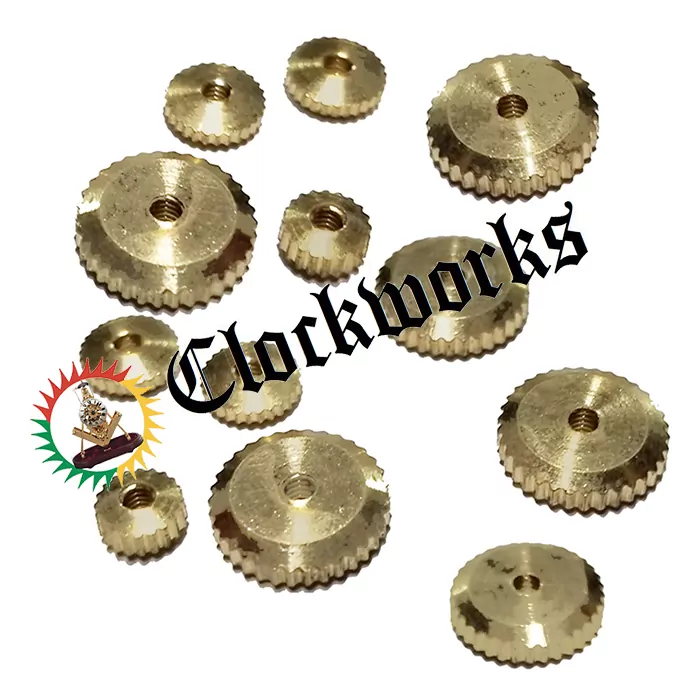
One of the most common parts a Mechanical clock needs is the hand nut. As we said before, the older the clock the harder things are to find. So, the hand nuts Clockworks offer are for movements made after the 1930’s.

Prior to 1930 clock hand nuts
There were not many standards on what the hand nut size should be on the early clocks. However, prior to around 1930 there is no telling what will work. In other words, it is literally trial and error. There was no standard hand nut size.
Subsequently, any hand nut we offer, may, or may not, work. This includes cuckoo hand nuts, American clock hand nuts, or German hand nuts. However, with even all of these assortments, there is a chance none of them will work on the clock.

Post 1930 clock hand nuts
Generally speaking, what we have to offer in the three types of clock hand nuts will cover most of the post 1930 Mechanical clocks.
The cuckoo hand nuts fit about 80% of the post war German made cuckoo clocks.
So, the American clock hand nuts fit many of the mechanical time strikes that were so popular. German hand nuts fit most post war German made mechanical clocks, with the exception being a few large grandfather clocks.
Clocks that do not take a hand nut
However, not all clocks require a hand nut. Some antique mechanical clocks require a clock hand washer and a tapered pin instead. These secure the minute hand as an alternative to the hand nut.
The washer may have a small square hole, or large, oblong or round hole. Clockworks offers an assortment of 100 clock hand washers that includes all the styles above. Use a taper pin to secure the hand with the washer on top of it.
Insert the taper pin into the hole in the end of the minute hand arbor to secure the washer and minute hand to the clock. A taper pin is a small brass or steel rod that is wide on one end and skinny on the other. Clockworks offers them in an assortment of 100 to ensure the right one is there.

Spade Hands
These are hands for German mechanical clock movements made after 1950. This includes Hermle, Urgos, Kieninger movements and more. Measure the hands by the time track diameter.
A time track is the small ring outside of the numerals and the minute hand length will be about half this diameter. Of course it also includes the hour hand which is naturally shorter. The minute hand has a 2.2mm square mounting hole, the hour hand has a 4.5mm round hole.
| Weight | 0.25 lbs |
|---|---|
| For Dial Size |
For a 4 inch (102mm) Dial (About 1 3/4in Minute hand) ,For a 5 inch (127mm) Dial (About 2 1/4in Minute hand) ,For a 6 inch (152mm) Dial (About 2 3/4in Minute hand) ,For a 7 inch (178mm) Dial (About 3 1/4in Minute hand) ,For a 8 inch (203mm) Dial (About 3 3/4in Minute hand) ,For a 9 Inch Wide Dial (About 4 1/2in Minute hand) ,For a 10 inch (254mm) Dial (About 4 3/4in Minute hand) ,For a 11-12 Inch Wide Dial (About 5 1/2in Minute hand) |
Related Articles
Frequently bought together




You may also like…

Maltese Clock Hands American
Mechanical Clock Spade Hands

Pierced Spade Clock Hands


I have a Howard Miller brass ship clock and need a replacement minute hand plus nut
The minute hand is about 1 3/4 inches long
These
https://www.clockworks.com/product/mechanical-clock-spade-hands
James Stoudenmire
40yr Clockmaker
Author of Clockworks.com
Looking for replacement hands for a mantle steeple clock, William Gilbert movement, 7″ dial. Not sure which ones to order. Also, tapered pin. Thank you.
American hands are at this link
https://www.clockworks.com/product/spade-clock-hands-american
Tapers here
https://www.clockworks.com/product/clock-repair-tapered-pins
James Stoudenmire
40yr Clockmaker
Author of Clockworks.com
I have a Howard Miller calendar clock which has a 11 1/2″ face needing new hands. The minute hand is approximately 5 1/4″. Do you sell replacement hands by any chance?
Do not have the calendar hand aspect of this
James Stoudenmire
40yr Clockmaker
Author of Clockworks.com
I have my new 351-020 movement installed and wall clock is running,all chimes are working but chime 5-7 minutes early. I removed the minute hand and have attempted to rotate the bushing as your instructions state but it does not move. Any additional steps I can take? Thank you.
Make it move, it will move. If you kill it we do offer them.
James Stoudenmire
40yr Clockmaker
Author of Clockworks.com
Thanks, it worked – thought I was going to break it but did not.
Re mechanical spade clock hands 12″. What diameter arbor. Its a German movement ca. 1900-1930 (JSGUS) Mine measures 6.4mmBolt for nut 2.69mm. Need nut also.
Thanks
Sorry do not have it. If you want to send the movement in for restoration we can custom create these obsolete hands in the duration
James Stoudenmire
30yr Clockmaker
Author of Clockworks.com
I need the hand nut to secure a 2 mm diameter thread (HM German Movement). Black preferred.
German hand nuts this link
https://www.clockworks.com/product/german-clock-hand-nuts
James Stoudenmire
30yr Clockmaker
Author of Clockworks.com
I have a Hermle 340-020 movement but need the hands for it for a mantel clock. Do you have a set of hands that I can use. I think the ones that were on it are “serpentine”. The hour hand looks like it is 2 1/4 inches from center hole to end. Thank you.
Bill Shull
Serpentine =
https://www.clockworks.com/product/serpentine-hands-for-german-mechanical-clocks
James Stoudenmire
30yr Clockmaker
Author of Clockworks.com
Very nice.
Which hands fit a 451-050h hermle movement?
Hi,
Any of these hands for German clock movements =|
https://www.clockworks.com/?post_type=product&s=German+hands
James
Does the minute hand of your Mechanical Clock Spade Hands have a bushing that allows rotation, to synch the chimes, etc.?
Mechanical Clock Chime On Time
These are the directions to get a German mechanical clock to chime on time. This means having the clock hands point to the right spot when the clock chimes. When replacing a clock movement, or getting new clock hands, either one, you will notice it will chime 5 minutes before it is supposed to, or 10 min after, something like this. This page explains how to correct this situation. It is unbelievably fast and easy to do.
Working with the minute hand
After a new mechanical movement is installed, or if you are just installing a new set of hands, it maybe noticed the clock will not chime at the time it’s supposed to. To correct this, take the minute hand off of the clock. This is the longer of the two hands. With this minute hand off of the clock, turn it upside down and look that it has a square hole where it attaches to the clock. This square hole is in a bushing that will rotate WITHIN the minute hand itself.
The correction
So, all to be done is just use needle nose pliers to turn this bushing ever so slightly. Put the hand back on the clock and see if it’s pointing to the correct place where it chimed. If it is, then it all set and it will point to the exact place it is supposed too. If it is still not right, take the hand off and try again. Once you get the minute hand to point where it just chimed you then set to the correct time.
The conclusion
It is really that easy, there is nothing to do with the clock itself, only the minute hand. In other words, to put it in a silly way, take the minute hand off of the clock and walk to the garage with it. Take it far, far away from the clock. When in your garage take needle nose pliers and turn the bushing within the hand itself. Then walk back to the clock and put it on. See if it’s now pointing to the right spot.
Do the Clock Hand come with the minute hand retainer nut? I have lost mine.
No, but they are offered at this link
https://www.clockworks.com/product/german-clock-hand-nuts
James