




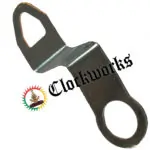
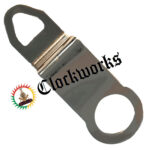
Quartz Clock Steel Hanger
$1.00
Quartz Clock Steel Hanger
Steel hanger for hanging a quartz clock movement. This hanger allows the clock to hang on the wall without attaching anything to the case. Fits AA battery movements only.
$1.00
SKU: Q-HANG
Categories: Clock Movements, Battery Operated Clock Movements, Quartz Clock Movement Parts and Accessories
Ships From: USA
Sold By: Clockworks Inc.
Returns: 30-day return policy
Secure Payment: Shop with confidence
About Quartz Clock Movements – Replace or build clocks with the compact single AA battery quartz clock movement – Clockworks
Please view these informational tabs to learn about time only quartz clock movements.
Quartz Clock Movement Removal
This note explains quartz clock movement removal from the case. The following does not apply to quartz units made in Germany or inserts.
To remove the movement, you need access to the back of the clock and the front side of the clock dial. There are so many case designs it would not be possible to cover all of the different variations.
The clock case went to together so it comes apart. It may take a bit of probing but there is always a way to take it apart because it went together.
Getting access to the dial area
There are many case designs and styles and there is no way for us to know how the current specific clock went together. Most of the time the removal process is very easy but of course there are some instances where it is not user friendly.
Thus, it is on the users end to be able to access the dial and movement area to continue with the swap out.
Clock hand removal
Quartz clock movement removal always needs the hands to come off first. There are two reasons for this.
First, need to have access to the hardware that mounts the movement. Second, there is no way to take get the movement out of the clock if the hands are still on it. They certainly will not fit through the hole in the clock.
Quartz Clock Movement Removal – Minute hand
Quartz clock movements have two styles of minute hands. One style has a nut that holds it in place and the other style is a friction fit.
The friction fit has no nut and just pulls off with a twist and pull. The second style has a minute hand nut to secure the minute hand. Removal is done by turning the nut to the left with needle nose pliers. Once the nut is loose it only requires fingers to unscrew it.
Hour hand
In a Quartz clock Movement removal task, the hour hand is only a friction fit. Thus, the hour tube tapers down on the movement, meaning it is wider on the low end of it.
This makes the hour hand friction fit only. Just twist the hand and pull it until it comes off.
Second hand
The second hand pulls straight up and off if the clock has one.

How to Install a Battery Clock Movement



Quartz clock movement measuring
Please select the post length when ordering a new quartz clock movement. Of course, when doing quartz clock movement measuring, remember the post will need to be able to go through the thickness of the dial face.
Also remember that the dial may or may not have a wood backing to it. With a wood backing the clock dial or face would be thicker and thus would need a longer post.
Clockworks offers multiple post lengths on quartz clock movements for this reason. In other words, the post has to be long enough to go through whatever thickness we are calling the dial.
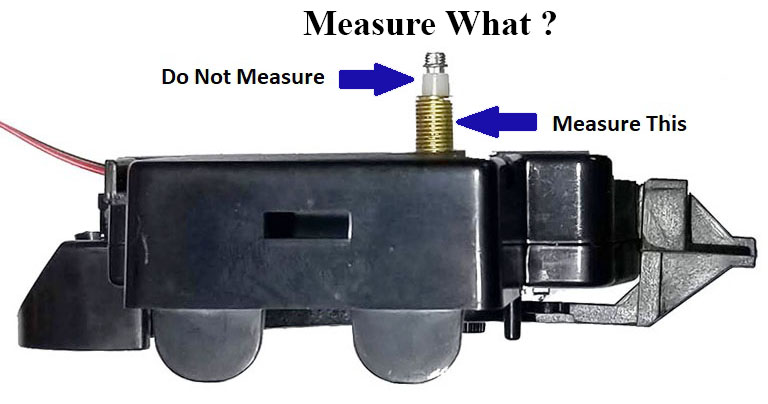
What to measure
Clockworks offers multiple post lengths for quartz movements. When completing a quartz clock movement measurement, you will need to measure the post on the old movement.
This is so it can match up with the new quartz movement. To clarify, the post is the part that goes through the dial (face) and mounts from the front and what is in a quartz clock movement measurement.
This applies to all Clockworks quartz movements, including chiming quartz, and time only quartz movements.
Length depends on dial thickness
When working on a quartz clock movement measurement the post has to be long enough to go through whatever thickness that the clock face/dial, might be. The length of the threaded portion of the post/shaft, is the measurement that you need.
The shaft with the threads needs to go through the dial/face of the clock from the back to the front. It needs to be long enough for a small hex nut to screw onto it. It can’t be too long or the hands will not move correctly.
Clockworks has a variety of quartz clock movement lengths to accommodate a variety of different materials since some are wood and some are metal and some are plastic, etc.
Measuring quartz post lengths
Above all, when replacing a quartz movement it means measuring quartz post lengths. Subsequently, the post will stick out through the front of the clock dial.
Of course, there needs to be enough threads sticking out for the hex nut to be put on. Hence, the movement will be held in place to the back of the dial (clock face) and will not move. Sometimes if the clock has glass over the face it is possible for the post to hit it.
Therefore it is important to measure the quartz post length correctly. In other words, if the post hits the glass, the hands will not be able to move. Thus making the clock not work.
Use the chart if building a clock
With that being said, find the correct quartz post length by using the chart below. So remember, the threads on the post need to be at least 2/16 longer than the thickness of the clock dial.
To clarify, a clock dial is the face (also known as the thing with the numbers on it). As always, email us if there is any question.
Measuring quartz post lengths if replacing a clock
If replacing a movement and not building a clock, it is easier to measure the quartz post length of the old movement.
Before measuring, remove the movement first by taking off the hands and then the hex nut. Next, measure the length of the post that has the threads that the hex nut was on.
In short, only measure the fat part of the hand shaft that we call a post. Also, never include the part that the hands go on when measuring the post length. All in all, the new unit needs to be the same post length as the old movement.
Overall, this applies to all quartz clock movements available on Clockworks such as chiming quartz and time only quartz.
Dial Thickness
- 1/16 inch thick
- 3/16 inch thick
- 5/16 inch thick
- 9/16 inch thick
- 3/4 inch thick
Size Post Needed
- 3/16″
- 5/16″
- 7/16″
- 11/16″
- 15/16″

Quartz-Battery Clock Movement Definitions
Easily replace a quartz clock movement by familiarizing yourself with these common terms. Below are the most frequently used definitions related to Quartz clock movements.
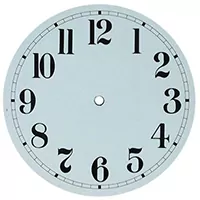
Dial
The dial is the part of the clock face that the battery movement post goes through. This is the part of the clock that displays the numbers. You can choose from two styles of dials: Arabic (regular) numbers or Roman (XII for 12) numbers.
Dials come in various shapes and sizes. Larger dials may require a High Torque clock movement instead of a Low Torque unit. You need a High Torque unit when the dial measures over 10 inches in diameter.
To determine the correct size, measure from the outside of the “9” across to the outside of the “3”.
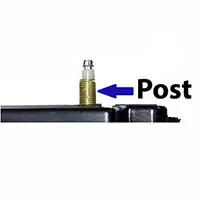
Post
The threaded part mounts the movement to the back of the dial using a hex nut. Most quartz movement posts measure 5/16″ wide, except for the QU22 unit, which features a 7/16″ wide post. Post lengths vary and are chosen when ordering the movement.
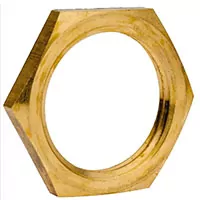
Hex Nut
A six-sided nut that secures the movement to the dial by threading onto the post. It should be tightened enough so the movement does not rotate when the clock case is moved.
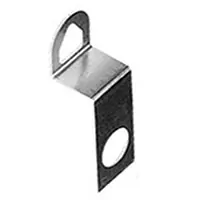
Hanger
An optional steel or aluminum piece that allows the clock to hang on the wall. The hanger slides over the post before you mount the movement to the dial. You will find it included with all time-only quartz movements, but not with all pendulum units.

Clock Hands
Also known as pointers, needles, or arms, these parts indicate the time. To order clock hands, measure from the center of the mounting hole to the tip of the minute hand.
The hour hand is proportionally smaller and comes as a set with the minute hand. Our American-style quartz clock hands use an “I” shaft, with the minute hand having an oblong hole and the hour hand having a round hole. In contrast, Chinese movements typically have round mounting holes for both hands.
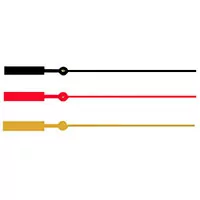
Second Hand
An optional, thin pointer that ticks out the seconds. You mount it by pressing it onto the pin inside the movement’s hand shaft post.
Quartz movements come in two types: Step Motion and Continuous Sweep Motion.
- The Step Motion movement moves the second hand in one-second intervals.
- The Continuous Sweep movement allows the second hand to glide smoothly around the dial.
Hanger Description
Experience a new way to display your favorite timepiece with our robust Steel Quartz Movement Wall Hanger. This innovative hanger provides a secure and minimalist solution for showcasing your quartz clock directly on any wall.
Unlike traditional methods that rely on the clock case, this hanger allows you to mount the clock by the movement itself. This approach is particularly ideal for custom projects or open-face designs. Furthermore, it is a perfect solution for eliminating the bulk of a large clock case when you want the focus to be purely on the hands and dial.
Since it is crafted from durable steel, this hanger ensures long-lasting stability for your clock. Additionally, its design specifically accommodates AA battery movements, offering a perfect fit for the most common quartz clock mechanisms.
Best of all, installation is incredibly straightforward. Simply slip the hanger securely over the hand shaft post on the front of your movement. Once in place, you can confidently hang your timepiece, transforming any wall into a functional and elegant display.
| Weight | 0.1 lbs |
|---|




PERFECT HANGER THX