


Blog


Grandfather Clock Pendulum Information
Grandfather clock pendulum information begins with the obvious discussion of length. The length of the pendulum on German units comes in a few CM options.
German units measure the pendulum from the top of the movement to the bottom of the nut threads.
The pendulum itself, the leader it hangs on, and the suspension spring that the leader hangs on.
All three components in centimeters make up that CM length in the drop down menu.
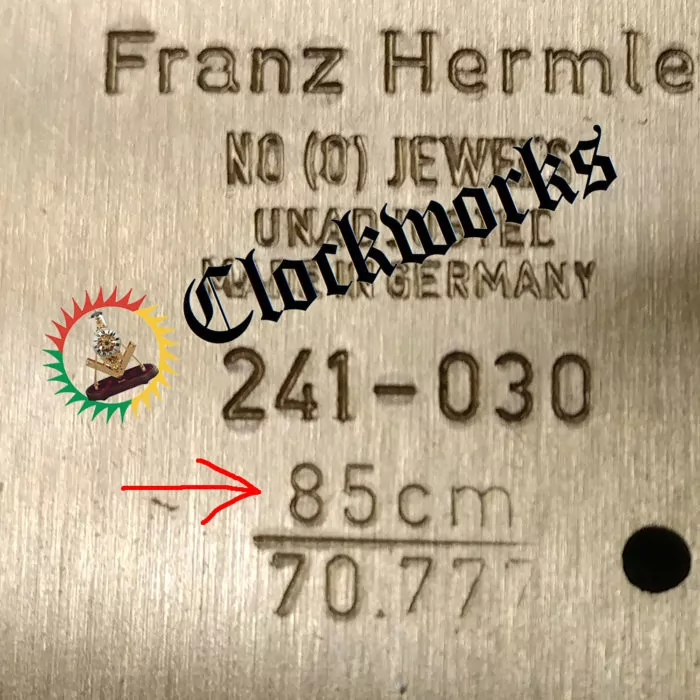
Pendulum length information
To know how long the actual pendulum is, subtract 15CM from the options with the pendulum length.
This will exclude the leader and suspension spring, and be the actual pendulum length from tip to tip off of the clock.
This length can vary as if a larger pendulum bob is selected, the actual length of the pendulum gets longer.
Why the CM length matters at all is because if the pendulum length is not near the CM length of the movement, the clock will not keep time.
So the gearing in the movement and the pendulum length works together to keep time around the specified CM length.

The bob width Options
A Lyre grandfather clock pendulum comes with either a 6 1/2, 8 1/2, or 10 1/2 inch bob diameters. The ‘Bob’ is the round disk at the bottom of the pendulum.
Moreover, the CM length on the movement will indicate the length of the pendulum from the TOP of the movement all the way down to the bottom of the pendulum nut threads.
This is an approximate length that depends on other factors such as bob diameter and weight of the pendulum.
Basically if the CM is 94CM the pendulum itself will be about 35 inches tip to tip off of the clock, and the 114CM option would put this same measurement at approximately 44 inches.
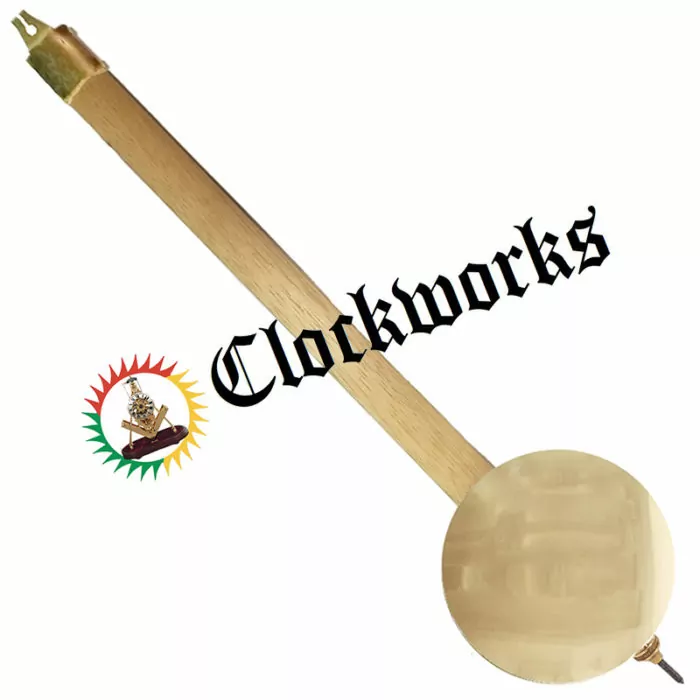




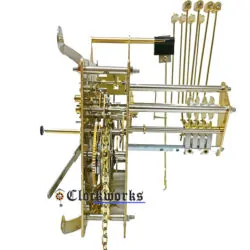
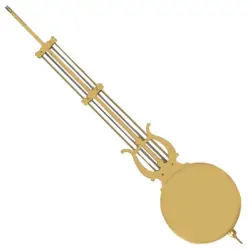


Hi i have a longcase clock of which the movemnt has no weights and no pendulum with bob. Its a hermly with nr 461-053H and the cm nr is 114, above what i believe is 68. Right at top of rear plate is a stamped 82. Judging whats been explained in the pendulum section, this may well be a 99cm pendulum length, or 100cm or so. I would really like to get this clock working again as i believe it only needs the 3 weights and the pendulum which i feel optimistic to create myself based on info so far gathered. Based on the details at backplate what would be suitable weights for this movement and if anyone could tell me what the 82 and the 68 means, thanks in advance
1982 – 68 beats per minute
That clock takes 1 weight at 7.7LBS and two weights at 9.9LBS from this link if the pendulum bob diameter is 8 1/2 inches wide or more
https://www.clockworks.com/clock-parts/clock-weights.html
Or it takes 2 weights at 7.7LBS and 1 weight at 9.9LBS from this link if the pendulum bob is less than 8 1/2 inches wide
https://www.clockworks.com/clock-parts/clock-weights.html
The heaviest weight would go on your right as you face the clock.
The lightest weight will go on your left as you face the clock.
The middle is light or heavy depending on the bob diameter.
(The larger bob diameters require more weight in the center.)
Please order either a wood stick pendulum, or a metal lyre pendulum for a Hermle 114cm movement,from the links below. The bob diameter is to be 4inches less than the interior width of the clock case, or less. This way it has some room to swing.
For a wood stick style pendulum, here is the link
https://www.clockworks.com/product/wood-stick-pendulum-for-hermle-clocks
Lyre pendulums are at this link
https://www.clockworks.com/product/hermle-lyre-pendulum
James Stoudenmire
40yr Clockmaker
Author of Clockworks.com
I have someone needing a pendulum for a tall case clock. It is a Ridgeway. The dial J5. Model #257. Mvmt HG. Finish GCH7 U7. Setup# 092487. Do you know length of it to be?
This is for a customer of ours.
What are the numbers off of the back plate of the clock movement itself? If it is hard to get to, usually you can stick a cell phone up behind the movement and get a picture of the numbers. Or through the side access panel if there is one.
Not off the paper work, not off the wooden case, but the movement stamp itself
James Stoudenmire
40yr Clockmaker
Author of Clockworks.com
Sorry for the long delay. Here is the back plate movement no. H 350-1511. And this has this as well: 94 cm. 000.66. Hope I get the right pendulum.
Is not the numbers off the back plate
What are the numbers off of the back plate of the clock movement itself? If it is hard to get to, usually you can stick a cell phone up behind the movement and get a picture of the numbers. Or through the side access panel if there is one.
Not off the paper work, not off the wooden case, but the movement stamp itself
James Stoudenmire
40yr Clockmaker
Author of Clockworks.com
Those are the numbers on the backplate . The numbers are H 350-1511. It could be reversed do to using a mirror, but those are the only numbers 94cm. 000.66
There are numbers on the brass back plate of the movement we need. Your looking at paper work or stickers on the clock case instead of the movement
James Stoudenmire
40yr Clockmaker
Author of Clockworks.com
If you have a pendulum with a 10 1/2″ bob, how wide of a case do you need for a grandfather clock?
15 inches wide or more is best
James Stoudenmire
30yr Clockmaker
Author of Clockworks.com
The complete pendulum arm has come off inside my William Curtis of Exeter Grandfather clock and I can not see where or how to reattach it. Can you help.?
The pendulum is 10 cm diameter and the arm 110 cm long.
Please ask this same question with pictures by email to clockworks@clockworks.com
James Stoudenmire
30yr Clockmaker
Author of Clockworks.com
looking for parts for a Howard miller 610-447 grandfather clock- need chains and pendulum with bob.
We need the movement numbers = What is the movement number off of the back plate of the movement itself?
This information would be directly off of the back plate of the clockworks itself stamped into the brass. Please see the attached picture as a reference.
(This information will not be on any of the paperwork that may have come with the clock, nor will it be on the wood case. This number will only be on the brass back plate of the movement itself only.) This is because the manufacturer that made your clock case used many different movements for the same clock case.
Thank you !