


Blog


Mechanical Clock Movement Beat-Setting
Mechanical clock movement beat-setting means the tick and the tock sound of the clock are even. In order to run, every mechanical clock that has a pendulum needs to be put in beat. It is amazing how many clocks have not run for 10 years or more just because this is not known. Often, clocks in tag sales, auctions, and homes only need to be put in beat to run but unfortunately they were left to sit for years. The setting of the beat is easy and takes less than a couple minutes to do.
Every Mechanical Pendulum Unit Needs It
Every mechanical clock that has a pendulum needs to be in beat to function. Part of owning a clock is to know how to do mechanical clock movement beat-setting. If this is not known how to do this, then whenever moving the clock from here to there it will stop after 5-10 minutes. So learning one simple solution will keep the clock running for years.
Putting a Post WW2 German Clock in Beat
By over swinging the pendulum,
most modern German mechanical clock movements can be put back into beat. This is also known as Auto Beat and is found in most post WW2 German clock movements. It’s the first thing to try when a clock will not stay running. It is ok to try this even if the clock doesn’t have auto beat built in. If the clock sounds like ticktock ticktock, instead of tick-tock tick-tock, or even tocktick tocktick, then it is not in beat. The clock may stop after 5 minutes, or even an hour, if it is still not in beat. Will also hear an uneven tick and tock. A rhythmic tick-tock tick-tock can be heard when it is correctly in beat.
Skinny Clock Case Beat Setting
If it is not an auto beat or the clock case has a narrow width, mechanical clock movement beat-setting is done differently. Push the top of the pendulum left or right as it hangs in its clock case. Hold a lower portion of the pendulum with the left hand and push the top of the pendulum left or right with the right hand. There will be some resistance in the pendulum when moving it left or right. The beat of the clock will change when the pendulum goes beyond this resistance. Don’t be afraid to move this pendulum top left or right as there is nothing to break. However, twisting the pendulum can break the suspension spring. It is only meant to go back and forth.
Mechanical Clock Movement Beat-Setting Notes
The beat is the rhythmic pulsations of the escape wheel clicking over one tooth at a time. This results in the tick tock sound as each tooth “escapes” from the rocking anchor that blocks it. The anchor rocks back and forth from the pendulum motion and is only on its arbor by friction fit. In other words, it will rotate independently of the arbor it is riding on. The tick or tock sends a jumping pulse action to what is known as a crutch. Then this crutch whacks the pendulum slightly with each swing. The back and forth momentum of the pendulum, in addition to the whacking motion made by the crutch, keeps it going and going. However, this is provisional depending on whether it’s even, left and right. Or in other words, the tick and tock are even. Once this happens, the mechanical clock movement beat-setting should be complete.
 Out of Beat
 Push Pendulum
 Beat Setting
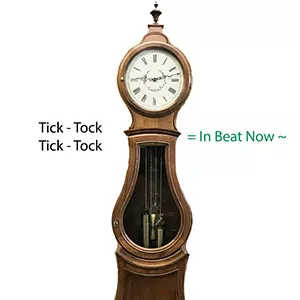 Now in Beat
How do I set the speed of my pendulumless mantle clock
Timing a balance clock movement
Balance Clock Movement Timing is done fairly easy. There are three types of clock balance movement styles post 1950. This section is for those balance units that do not have a platform escapement. The platform escapement can be read about in another section. These notes are only for the larger balance wheel in the top center of the clock movement.
For example, movements in the Urgos 6/ series and many of the Hermle clock movements. Hermle movements such as 340-020 and 350-020. Out of these, two styles, the old style and then the new style.
Use of the old style was all through the 70’s and 80’s and 90’s. Around this time there was a switch to the new style on the Hermle units. By this time the Urgos units were out of production.
The old style
The old style is one with a round spring that goes up and down (Vertical). It goes in a circle around the center arbor of the balance wheel. In this style there is a slide arm with a tiny weight on the balance wheel itself. There is a + and – on the wheel. To speed up time go towards the plus sign.
However this style is not always easy to regulate and can be very hard to get it perfect. The factory has special devices to make it perfect. However it’s not that easy on the customer end with this style balance. For this reason it has been improved upon during future manufacturing.
If the old style balance then the clock movement has some age to it. If this is the situation it is just best to replace the unit with the new one. Clockworks offers the movement brand new with the new style balance for less than the cost of a cleaning.
The clock movement has lasted 25 years or more. In theory the new unit should last more than this with the improved aspects.
The new style
The non pendulum units offered on this page all have the new and improved balance assemblies. Despite the change on the balance, these units are a direct fit and will install in the clock case the exact same way as the old unit.
If the numbers match from the old unit to the numbers offered on this page, than the movement will be the exact same. It will be the same as it is now but brand new and with the improved balance. The improved upon balance units have a different kind of hairspring (Horizontal). It will also have a screw to regulate it rather than a slider arm.
The regulator screw is on the back of the movement near the balance. There is a + and – sign next to it meaning fast or slow. If the clock needs to be faster to keep time then the screw would be turned to the plus and opposite for slowing time. The factory times the balance movement before the new movement ships.
The movement has a slider arm on the threaded portion of the timing adjustment screw. This arm pulls or pushes the horizontal hair spring and makes the clock run faster or slower. When the movement leaves the factory this arm is in the center of that threaded rod and is timed while the arm is at that location.
During shipping it is possible for this arm to jump out of its center position and, in turn, make the timing out of whack. The solution to this is to first just lift that timing arm with fingers and move it to the center of the threads again. This is where timing begins.
After it is in the center of the threads it will be pretty close in timing and only will need fine adjustment with the screw, moving it too the plus sign for faster, minus sign for slower.
James Stoudenmire
40yr Clockmaker
Author of Clockworks.com
These are the only numbers I see on my grandmother clock I bought in the 1970’s
UW32/1A & Serial#302346
The pendulum got lost moving from CA to Phoenix. AZ. The clocks face says Tempus Fugit
I need to find a pendulum.
Please order a pendulum for as Urgos 80cm movement from this link
https://www.clockworks.com/product/uw-urgos-stick-clock-pendulum
or
https://www.clockworks.com/product/urgos-uw-lyre-style-clock-pendulum
You would need to select a bob diameter that is 4 inches smaller than the inside width of the clock case.
James Stoudenmire
40yr Clockmaker
Author of Clockworks.com
My mother has a Ridgeway grandmother clock model-167 with movement-E. She knocked the pendulum off the other day while pulling the weights up. When I rehung the pendulum the clock no longer ran the pendulum swings for maybe 20 seconds at best. The suspension spring had a wobble to it when I opened the back of the clock up so I bent it back into shape gently and re started the pendulum. while observing the the clock after starting the pendulum I noticed that the second gear wasn’t rotating like it should. So I removed the pendulum and mimicked the motion on the pendulum hanger and it seems like the swing needs to be wider than the clocks case now to get the second gear wheel to move like it should. I am hoping that a replacement suspension spring would fix this and that you would be able to provide me with the correct one for this movement. I am not sure how rough my mother was with the clock when she attempted to rehang the pendulum after knocking it off its holder. Any help and advice you have for us would be greatly appreciated. Thanks for your time
Tim.
What are the numbers off of the back plate of the clock movement itself? If it is hard to get to, usually you can stick a cell phone up behind the movement and get a picture of the numbers. Or through the side access panel if there is one.
Not off the paper work, not off the wooden case, but the movement stamp itself
James Stoudenmire
40yr Clockmaker
Author of Clockworks.com
James,
There are two numbers JW32/1A and 675667. Thanks again for your help
Tim.
The Urgos 32 series requires these components for the top section of the pendulum assembly where it interacts with the movement. The pendulum assembly from the top down consists of the suspension spring that hangs from the top most post sticking out of the back of the movement. Then comes the leader that hangs onto the suspension, the leader is a sort of flat long bar that the pendulum actually hooks on to. So its the suspension on the top, the leader hangs on it, then the pendulum hangs on the leader with the pendulum top hook.
Suspension A2 from this link usually
https://www.clockworks.com/product/mechanical-clock-suspension-spring
Suspension B2 from this link rarely
https://www.clockworks.com/product/urgos-clock-pendulum-suspension
Leader C if the movement has some age
https://www.clockworks.com/product/urgos-clock-pendulum-leader-2
The pendulum top hook for a wood stick pendulum is available at this link
https://www.clockworks.com/product/urgos-clock-pendulum-top-hook
James Stoudenmire
40yr Clockmaker
Author of Clockworks.com
Thanks for your help James we will get that on order and I will let you know how it works out
Tim.
The suspension spring solved the problem. The clock has been running for hours now and everything seems fine but I do have one more question for you. The one rubber head on my one hammer is looking worn compared to the others. this seems to be causing its sound to not be as loud as the others. On the Urgos 32 movement it is the the hammer that is closest to the clock face that goes off on the 1/4 hr. Would the simplest solution be to bend the hammer head slightly closer to the chime rod to compensate for this or do you folks sell the rubber heads too?
Both.
Hammer adjustment =
https://www.clockworks.com/posts/clock-chime-hammer-positioning
Hammer heads and tips =
https://www.clockworks.com/product/clock-chime-hammer
James Stoudenmire
40yr Clockmaker
Author of Clockworks.com
The clockis running fine but looses 10 min in 24hr. The pendulum is as high as it will go. What am I doing incorrectly. The beat sound and looks good.
Shorten the pendulum by 1 1/4 inches, this will solve. Or shorten the pendulum hanger, either way works.
James Stoudenmire
40yr Clockmaker
Author of Clockworks.com
I have a pendulum custom made 60 yr old. I have cleaned it and have ir running on the stand for3 days have it running on the stand but when I mount it back in the case it only runs for a couple of min. Wall hanging case and every thing is level. What am I doing incorrectly. Oh yes the pendulum spring you sent work fine
Tommy
From here, not sure. Would you like to send it in?
James Stoudenmire
40yr Clockmaker
Author of Clockworks.com
James, Thank you very much for the offer but I feel that I amvery new to working on clocks and must learn how to fix it and take care of it correctly. It was not working at ll when I started on it and is working a little now.
Thank you again and have a very blessed week.
Tommy
I have a 1973 Colonial grandmother clock with a jauch movement. I had to replace the suspension spring and since then the clock keeps running slow. I have tried moving the adjustment on the bottom of the pendulum up, but it does not seem to be helping. It actually makes it run slower. The clock has been oiled and is running better just running slow. Any suggestions?
Keep raising the pendulum bob, it will speed up
James Stoudenmire
40yr Clockmaker
Author of Clockworks.com
Thank you, I will do that.
If I set my Howard Miller Grandfather clock slightly off level, I can get a perfect beat, If the clock is level the beat is way off center. Is it Okay to run it this way? Thank you for all the information you provide.
Yes. Being level is not so important, being out of beat however the clock will never run
James Stoudenmire
30yr Clockmaker
Author of Clockworks.com
Thank you, James. I won’t be worried about it now.
James,
How do I get to the correct Tic Toc sound, Do you have instructions to follow to get this done? Like make sure that new mech is setup to be parellele to floor going front to back and side to side?
Thanks,
Ralph
Please see this post
https://www.clockworks.com/posts/mechanical-clock-movement-beat-setting
James Stoudenmire
30yr Clockmaker
Author of Clockworks.com
Best explanation and diagram of being in beat I’ve seen.
No tick tock sound at all and pendulum won’t stay running. Is it time for a new movement. Current movement is 30+ years. It is is Hermle 450 050
Time for the new one.
Please order the 451-050 from this link
https://www.clockworks.com/product/new-451-050-clock-movement-by-hermle
The CM length off the back plate is also needed. Also please see pics of the movement comparison on high bridge or low bridge so the correct one is selected
James Stoudenmire
30yr Clockmaker
Author of Clockworks.com
Are new Hermle movements pre oiled when received from Clockworks? I just received a new Hermle movement and wonder if it needs oiling.
Yes it sure is, it is all oiled and all set
Oiler to buy in 5-10 years is at this link
https://www.clockworks.com/product/needle-pen-clock-oiler
James
pendulum runs a short while and stops
how do I talk to someone to help me get my pendulum swinging with my new movement