


Blog


Mechanical Grandfather Clock Weights in a variety of options. Get any part of the weight or the weight complete for your clock, using the weight chart Full article »
Please view these information tabs to learn about our Mechanical Grandfather Clock Weights
Grandfather Clock Weights Description
The Grandfather Clock Weights Description on this web page will cover what is meant by weights and their parts. Any part of the weight is available on its own. We also offer complete weights. If needing a complete clock weight, we need to determine what the appropriate weight is for the clock.
This requires getting the information off of the back plate of the brass movement itself. This information will not be on any of the paperwork or clock case. Once the movement number is known, cross reference that with the weight chart.
The diameter of the bob in another piece of information that needs to be known. The bob is the round disk at the bottom of the pendulum.
The weight chart
Before using the chart, you need to know who made the clock movement. This can be deceiving because the movement can have any name on it, but it may not be the true maker.
For example, a Hermle unit may have the name Sligh, Ridgeway, Howard Miller and so on.
The numbers on the movement is what will lead to getting the correct manufacturer of the movement not the names on the movement. The stamp with these numbers are right on the back plate. Use the movement identification page to find out who made it.
Once the manufacturer is known and the starting numbers of the movement, use the chart to see the weight specifications for the Grandfather clock weights.
Avoiding the weight chart
There is also another way to go about this task, which may be easier. If the movement was made in Germany, post WW2, we can safely make the following assumptions.
If the movement is square and chain driven, it will require [email protected] lbs and [email protected] lbs. These are available in either 47mm or 43mm diameters.
If the pendulum bob is 8 1/2 inches or more, change that rule to [email protected] lbs and [email protected] in 47mm or 43mm. A movement that is rectangle in either chain or cable will use [email protected] and [email protected] LBS in 60mm diameter.
This changes to [email protected] and [email protected] in 60mm diameter if the pendulum bob is 8 1/2 inches or wider. These specifications do not apply if the clock has 5 or 9 big tubes on the back. Also this rule is not for all Grandfather clock weights but the vast majority of the post WW2 German units.
Close enough is good enough
The weight specs list it as 4.7 or 6.6, however this is really being too picky. If getting it close to those numbers that is fine. In fact if ordering a 4.7 lb weight, it may come 5.3 or whatever, but that is just fine.
There has to be some sort of reference for the factory to label the Grandfather clock weights so it is what it is. Just know if it is a pound over that is fine. If it’s a little under, that is fine also. They do not have to be exact.
Often wrong from the start
In fact, there is a lot of clocks in the world sold new with the wrong Clock Weights on them from the start.
Clockworks will do a repair and they will say the clock ran for 30 years straight and come to find out they had Grandfather clock weights that were a pound or two too heavy. If the weights are a little too heavy it is fine. A lighter weight may or may not be fine because it may not trigger the movement to work properly.
Grandfather Clock Weights Description – Conclusion
Grandfather clock Weights are not cheap mainly because they are so heavy to keep, ship, store, move from here to there.
Sure one weight set of three is less than 30 lbs but that adds up quickly in a stack of weight sets.
With that said, we don’t want to ship these back and forth. It is best to get the right weights the first time. To return these is not an inexpensive or easy task. For example, suppose we charge $30 to ship these and for some reason they are wrong. Then it is $30 to get them back to us and another $30 to send out a new set.
In addition, UPS charges a fee to send a call tag for them to come back. That is $110 to UPS for no reason. So if there are questions, please ask.
Grandfather Clock Weights Stuck
The Grandfather clock weights can get stuck in the high position if over wound. Some larger clocks have over wind protection to prevent this.
The grandmother and grandfather chain drive units often do not have this feature. When winding the weights up make sure the top of the weight can be seen when done. Never go to the point where the top of the shiny weight cover can’t be seen.
Chime weight stuck
The chime weight is on the right as you face the clock and has the heaviest weight. Using cloth gloves, or at least a cloth of some kind, pull down on the weight some.
This is the same as making the weight weigh more. At the same time, turn the minute hand past the quarter hour to see if it will engage the chime. When you advance the time and make it chime, the weight will slowly come down. This will hopefully be enough to activate and run the chime on its own.
Time weight stuck
The time weight is the center weight which can be light or heavy depending on bob size.
This is the hardest weight to deal with out of the three. Try pulling down some while swinging the pendulum.
See if it starts running on its own when letting go. If this does not work, take off the pendulum. All it will have is the pendulum leader hanging on the back of the movement.
This will make it tick tock faster than if the pendulum was on. The leader will tick tock faster as you pull down some on the weight. The weight will then come down enough to run the clock.
If all else fails, and it’s a chain driven clock, you would need to cut the chain in half, or break a link, to take the movement out of the clock. With the movement out of the clock you can fix it.
Strike weight stuck
The strike weight is on the left as you face the clock and has the lightest weight. Only after the chime weight is operating correctly can you work on the strike weight.
If the clock does not run through the chime sequence it will not get to where it strikes out the hours. With some cloth gloves on, or at least a cloth of some kind, pull down on the weight some.
Again, this is the same as making the weight weigh more. Doing this will make the clock strike. Advance the minute hand and let it chime each quarter until it plays the top of the hour song. Then pull a little on the weight when it is going to strike out the hours.
Keep advancing the time with the minute hand, as to make it chime and strike. Then slowly the weight will come down enough to be able to activate and run the strike on its own.
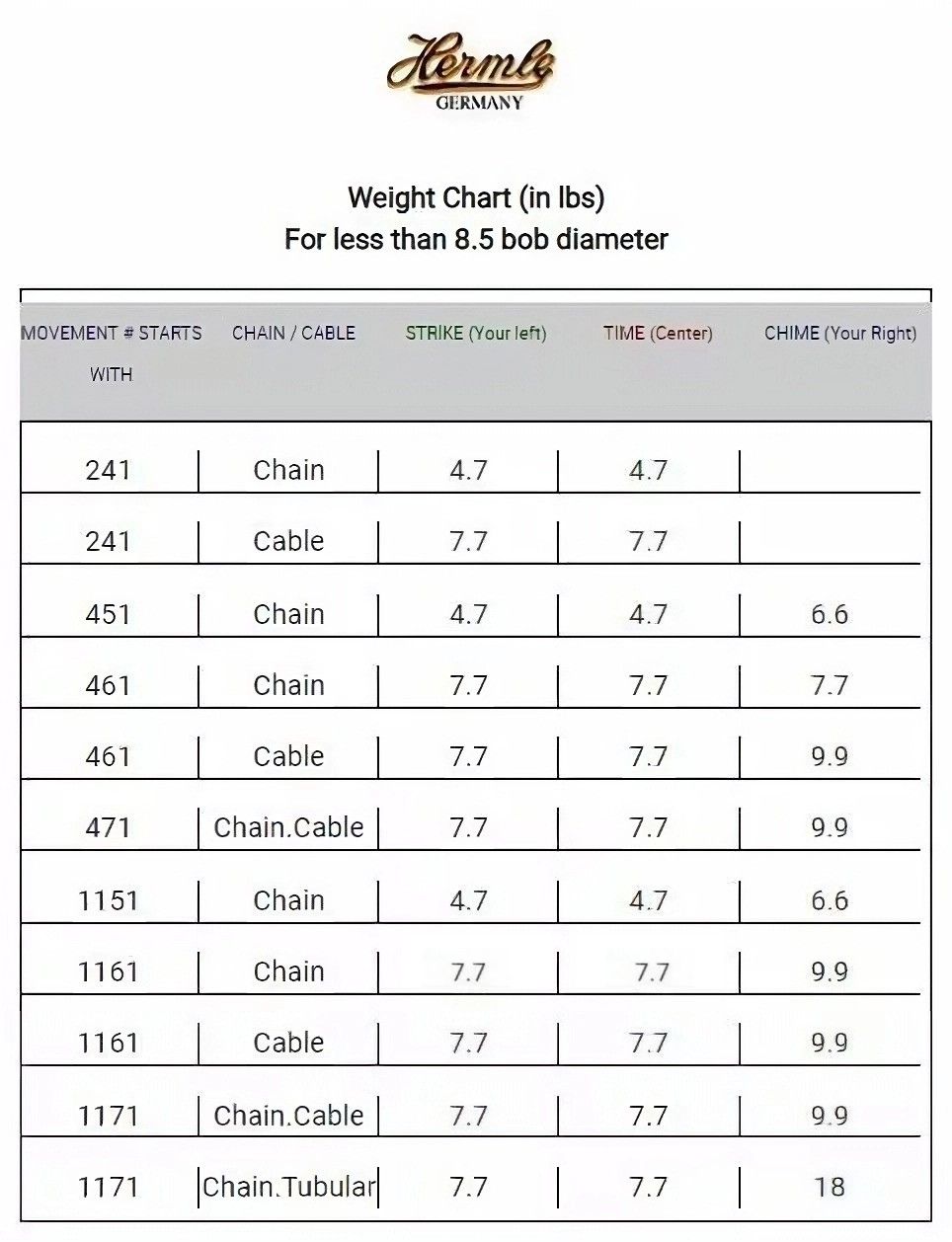 If the pendulum bob is 8.5, or larger, the time weight should be the same as the chime weight instead. (Tubular Bell movements are an exception)
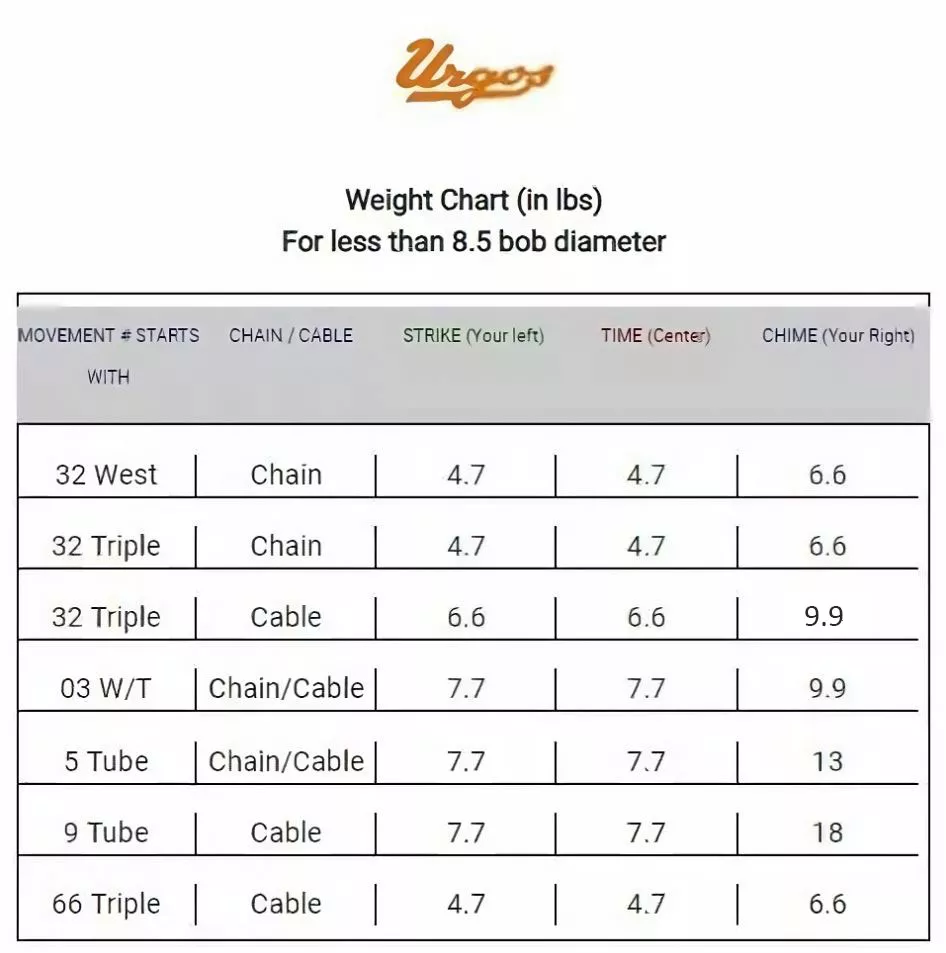 If the pendulum bob is 8.5, or larger, the time weight should be the same as the chime weight instead. (Tubular Bell movements are an exception)
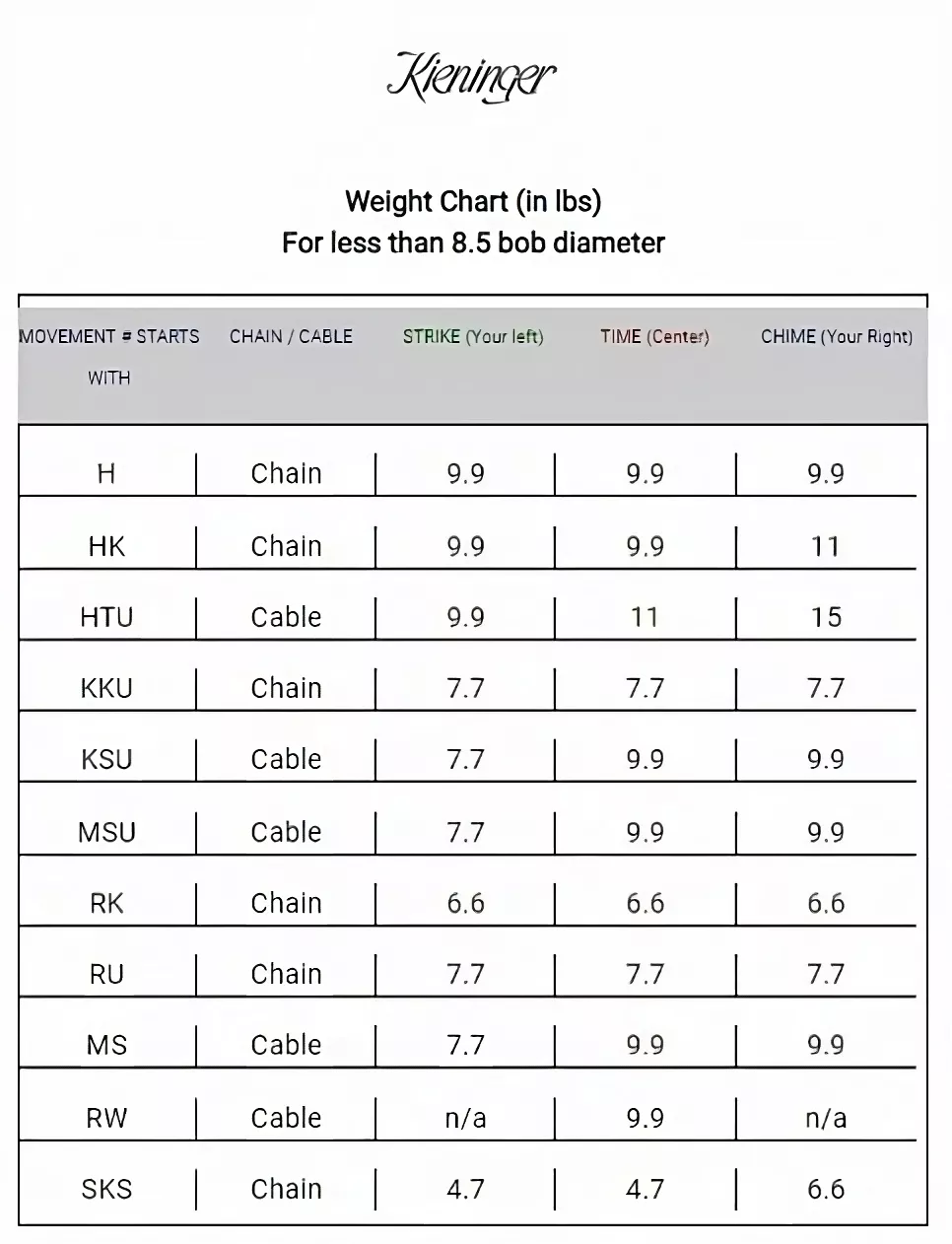 If the pendulum bob is 8.5, or larger, the time weight should be the same as the chime weight instead. (Tubular Bell movements are an exception)
Changing a Clock Cable
Changing a clock cable requires the movement to be out of the clock case. These instructions refer to post WW2 modern grandfather units of German origin, however all makes have a similar method. Swapping the cable is easy. There is a big hole and a little hole on the cable mount.
The cable end fits into the big hole, then slides over to seat into the little hole. When the lock is set, it seats in securely. It’s the same basic theme on both ends of the cable, meaning, one slot being in the cable drum itself and the other on the movement.
The cable drum side of the cable
To remove, lift the cable up from the oblong hole on the drum and slide it over to the big side. The cables have ends made of brass on them. These get slid over from the small side of the slot on the cable drum to the larger slot. It will release so as to remove it from the clock movement.
The other end of the cable
The movement itself would normally have the plates set for the cable ends. The cables have round brass ends on them and these lock into a plate on the movement.
This plate will have a small hole leading to a big hole. To remove the cable it requires only lifting the end and moving over to the big hole and out.



I have a large wall clock that is a pin wheel clock. It has been “repaired” once and it ran for about 6 months by another local company, then it stopped. I had removed the works and am not sure exactly what I did, but it ran quite well for another month. It won’t run now. It is a regulator clock and it seems like something is binding on the shaft for the hour hand, since I’ve had limited success getting it to run without the hour and second hands. Does this seem like something that you could work on? The c,OKC has been in my family for over 100 years and I’d like to have it running again.
Please ask this same question with some pics of this clock and email clockworks@clockworks.com
James Stoudenmire
40yr Clockmaker
Author of Clockworks.com
Hi there – I’m the UK – this is all fascinating stuff! I have inherited an Urgos floor clock but the chains have gone astray? What chains do I need to buy for a movement with the numbers uw3/15 and 40535 stamped on the back. And could you tell me a bit more about its history? Many thanks.
The numbers stamped on the back of your movement—”UW3/15″ and “40535”—indicate this is an Urgos triple-chime grandfather clock (floor clock) movement from the German maker Urgos (Black Forest region, founded in 1920; production later continued under Hermle after Urgos ceased independent operations).UW3/15 is an older-style designation for what is now commonly referenced as the UW03124 (or equivalents like 03124, 03109, 3/15 converted by replacing the slash with zeros). This is a chain-driven, three-weight mechanical movement.
It features triple chimes (Westminster, Whittington, and St. Michael melodies), selectable every quarter hour, with full melody plus hour striking on the hour.
It typically uses 12 hammers/rods for the chimes and is designed for floor/grandfather clocks with an ~100cm pendulum length and 53mm hand shaft.
The “40535” is likely the serial number (or a production/batch code) stamped on the back plate, common for dating or identifying specific units—Urgos movements often have such individual numbers alongside the model code.
This series was popular in American-made grandfather clocks from brands like Ridgeway, Howard Miller, Ethan Allen, Daneker, Barwick, and others during the 1960s–1980s (and sometimes earlier/later), when many imported German movements for chiming floor clocks.
James Stoudenmire
40yr Clockmaker
Author of Clockworks.com
Thanks James! That’s interesting stuff! Do you stock replacement chains?
We do yes =
https://www.clockworks.com/?s=chain&post_type=product
James Stoudenmire
40yr Clockmaker
Author of Clockworks.com
I have a Seth Thomas Tempus Fugit Grandfather clock and need just the case, with the hook, for one weight. Do you carry that?
Yes, this link
https://www.clockworks.com/product/polished-clock-weight-shell-only
James Stoudenmire
40yr Clockmaker
Author of Clockworks.com
I have a grandfather clock with the name Jauch PL 103 of the back of the mechanism. One of my cables broke for the left weight. Do you know what type of cables I would need for this? Thanks so much
Are you sure this one is cable driven and not chain? Do you mean the chain broke?
James Stoudenmire
40yr Clockmaker
Author of Clockworks.com
I have a Kininger MSU09 116cm movment, 10″ pendulum and am trying to find out what size weights I need but I can not find a consistant answer. I’ve seen I need 7lbs,9,9; 5,5,5: etc My best guess is I need the 7,9,9 combo. Is this correct? Why am I finding so many different answers?
Ignore AI or others as they are often wrong.
That clock takes 1 weight at 7.7LBS and two weights at 9.9LBS from this link if the pendulum bob diameter is 8 1/2 inches wide or more
https://www.clockworks.com/clock-parts/clock-weights.html
Or it takes 2 weights at 7.7LBS and 1 weight at 9.9LBS from this link if the pendulum bob is less than 8 1/2 inches wide
https://www.clockworks.com/clock-parts/clock-weights.html
The heaviest weight would go on your right as you face the clock.
The lightest weight will go on your left as you face the clock.
The middle is light or heavy depending on the bob diameter.
(The larger bob diameters require more weight in the center.)
James Stoudenmire
40yr Clockmaker
Author of Clockworks.com
I just purchased a grandfather clock. It came with two left weights and one center weight. There was no right weight included. I bought it from a store that was going out of business So I can’t go back to them. How would I get the correct right sided weight?
What are the numbers off of the back plate of the clock movement itself? If it is hard to get to, usually you can stick a cell phone up behind the movement and get a picture of the numbers. Or through the side access panel if there is one.
Not off the paper work, not off the wooden case, but the movement stamp itself
James Stoudenmire
40yr Clockmaker
Author of Clockworks.com
Hello Clockworks, Joe here, I have a Black face Lagache Greal mantel clock from Beauvais, with several numbers stamped on back of clockworks and I am trying to identify which one would be the appropriate one for the pendulum weight; numbers are 3502, 4 (space) 4 and 8,606. It’s also stamped BTE or BTL. Any suggestions as to which to use?
Best to send some pics to clockworks@clockworks.com and ask the same question over there, so I can see
James Stoudenmire
40yr Clockmaker
Author of Clockworks.com
I currently own a Howard Miller grandfather clock model 611-078 the Duvall clock. Do you sell the Suspension Sping for this clock. It is a Keinger movement. The two stamp numbers from the movement back plate are as follows.
1733021124
the other stamp numbers is as follows:
MS001
116 cm
354-418
With these numbers provided do you sell the Suspension Sping for this movement. If so can you direct me to the link to pur have, thank you.
Suspension A3 from this link
https://www.clockworks.com/product/mechanical-clock-suspension-spring
James Stoudenmire
40yr Clockmaker
Author of Clockworks.com
Thank you James for the information.
Need weights for my 610-134 Howard Miller clock called the escuire
What are the numbers off of the back plate of the clock movement itself? If it is hard to get to, usually you can stick a cell phone up behind the movement and get a picture of the numbers. Or through the side access panel if there is one.
Not off the paper work, not off the wooden case, but the movement stamp itself
James Stoudenmire
40yr Clockmaker
Author of Clockworks.com
Need wights for a Waterbury mantel clock patent date 1871.
That one does not take weights if it is a mantle clock. Please explain
James Stoudenmire
40yr Clockmaker
Author of Clockworks.com
I sent pics to Stephanie on 10/12. I misnamed it as a mantel clock. It should have weights which are suspended by string (see pic).
Did not see pics. Please ask the same question with pics and send to clockworks@clockworks.com
James Stoudenmire
40yr Clockmaker
Author of Clockworks.com
What wgts do I need for a Waterbury 1871 clock? I sent pics to you previously and also to Stephanie.
From here, not sure. Best to send it in for restoration and we can figure it all out.
Sending in?
James Stoudenmire
40yr Clockmaker
Author of Clockworks.com
No. I finally got weights from ebay after help from JustAnswer. Watson are 3 1/2#’s each side. Clockseems to work ok. Thanks for your help.
Art
I have a Westminster grandfather clock that I need the weight that makes the music box work. Can you tell me what size weight I need for that mechanism?
What do the other weights say on them as far as the gram amount that is stamped?
James Stoudenmire
40yr Clockmaker
Author of Clockworks.com
Hello I have a Seth Thomas A403-007 a number stamped above is 7810. I don’t know if it’s a Grandmother or Grandfather clock. I need to know which weights to purchase. On the pendulum of the round thing is called a bob it’s in between 4.5 and 4.75” wide. Any help would be greatly appreciated. Thank you in advance.
Linda Marie Stiles
Clock needs 1 weight at 4.7LBS and two weights at 6.6LBS from this link if the pendulum bob is 8.5 inch or more.
https://www.clockworks.com/product-category/all-clock-parts/mechanical-grandfather-clock-weights
Clock needs 1 weight at 6.6LBS and two weights at 4.7LBS from this link if the pendulum bob less than 8.5 inch wide
https://www.clockworks.com/product-category/all-clock-parts/mechanical-grandfather-clock-weights
The heaviest weight would go on your right as you face the clock.
The lightest weight will go on your left as you face the clock.
The middle is light or heavy depending on the bob diameter.
(The larger bob diameters require more weight in the center.)
James Stoudenmire
40yr Clockmaker
Author of Clockworks.com
What are the correct weights for a Hermle 451-050H movement?
Clock needs 1 weight at 4.7LBS and two weights at 6.6LBS from this link if the pendulum bob is 8.5 inch or more.
https://www.clockworks.com/product-category/all-clock-parts/mechanical-grandfather-clock-weights
Clock needs 1 weight at 6.6LBS and two weights at 4.7LBS from this link if the pendulum bob less than 8.5 inch wide
https://www.clockworks.com/product-category/all-clock-parts/mechanical-grandfather-clock-weights
The heaviest weight would go on your right as you face the clock.
The lightest weight will go on your left as you face the clock.
The middle is light or heavy depending on the bob diameter.
(The larger bob diameters require more weight in the center.)
James Stoudenmire
40yr Clockmaker
Author of Clockworks.com
I have a Ridgeway serial 90047027 I only have I full weight mark L then I have one more with out the top and bottom part in side the metal weight is mark ridgeway 63 can you please help me thanks
What are the numbers off of the back plate of the clock movement itself? If it is hard to get to, usually you can stick a cell phone up behind the movement and get a picture of the numbers. Or through the side access panel if there is one.
Not off the paper work, not off the wooden case, but the movement stamp itself
James Stoudenmire
40yr Clockmaker
Author of Clockworks.com
I am trying to determine the weights needed for a 84 k 100 cm kienenger grandfather clock
That clock takes 1 weight at 7.7LBS and two weights at 9.9LBS from this link if the pendulum bob diameter is 8 1/2 inches wide or more
https://www.clockworks.com/clock-parts/clock-weights.html
Or it takes 2 weights at 7.7LBS and 1 weight at 9.9LBS from this link if the pendulum bob is less than 8 1/2 inches wide
https://www.clockworks.com/clock-parts/clock-weights.html
The heaviest weight would go on your right as you face the clock.
The lightest weight will go on your left as you face the clock.
The middle is light or heavy depending on the bob diameter.
(The larger bob diameters require more weight in the center.)
James Stoudenmire
40yr Clockmaker
Author of Clockworks.com
What are the correct weight values for a Kieninger 78R 93CM grandfather movement.
Thank you
Dave
Clock needs 1 weight at 4.7LBS and two weights at 6.6LBS from this link if the pendulum bob is 8.5 inch or more.
https://www.clockworks.com/product-category/all-clock-parts/mechanical-grandfather-clock-weights
Clock needs 1 weight at 6.6LBS and two weights at 4.7LBS from this link if the pendulum bob less than 8.5 inch wide
https://www.clockworks.com/product-category/all-clock-parts/mechanical-grandfather-clock-weights
The heaviest weight would go on your right as you face the clock.
The lightest weight will go on your left as you face the clock.
The middle is light or heavy depending on the bob diameter.
(The larger bob diameters require more weight in the center.)
James Stoudenmire
40yr Clockmaker
Author of Clockworks.com
Thank you….. much appreciated. That information is of great help in sorting the weight issue for this movement.
Junghens grandmother clock. Movement w103 294 ….lost weights. Size and weight needed they seem to go onto thin strings with small springs and rings on
What are the numbers off of the back plate of the clock movement itself? If it is hard to get to, usually you can stick a cell phone up behind the movement and get a picture of the numbers. Or through the side access panel if there is one.
Not off the paper work, not off the wooden case, but the movement stamp itself
James Stoudenmire
40yr Clockmaker
Author of Clockworks.com
This is Ethan Allen and the weights are 4 3/4″ by 2″ and weigh 4.5 lbs. each
We have the outer shell only also to offer at this link, what you need 47mm wide
https://www.clockworks.com/product/polished-clock-weight-shell-only
Clock needs 1 weight at 4.7LBS and two weights at 6.6LBS from this link if the pendulum bob is 8.5 inch or more.
https://www.clockworks.com/product-category/all-clock-parts/mechanical-grandfather-clock-weights
Clock needs 1 weight at 6.6LBS and two weights at 4.7LBS from this link if the pendulum bob less than 8.5 inch wide
https://www.clockworks.com/product-category/all-clock-parts/mechanical-grandfather-clock-weights
The heaviest weight would go on your right as you face the clock.
The lightest weight will go on your left as you face the clock.
The middle is light or heavy depending on the bob diameter.
(The larger bob diameters require more weight in the center.)
James Stoudenmire
40yr Clockmaker
Author of Clockworks.com
I need an end cap for a weight. I measured but I don’t see any products with the same size. My measurement came to 2.069014” or 52.5529556mm. What am I doing wrong.
Do not seem to have that one
James Stoudenmire
40yr Clockmaker
Author of Clockworks.com
Thank you
I’m working on an antique g’father clock. But, I’m stumped. Weights are correct—heavier on the right. It’s level. I’ve used canned air to remove dust. It’s been oiled.
It runs anywhere from 3-5 min and then stops. Seems to miss catching the wheel about the same spot each time. I reversed the weights and it ran for almost 9 min before stopping again.I’ve reversed them back to heavier on the right. There are only 2 weights and it only chimes the hour.
Any suggestions?
I hold my breath at the 40 sec and 10 sec points for the escapement wheel and sometimes it acts as if it will stop but then catches and keeps going. But next cycle, it stops. Same place🤷🏻♀️
What are the numbers off of the back plate of the clock movement itself? If it is hard to get to, usually you can stick a cell phone up behind the movement and get a picture of the numbers. Or through the side access panel if there is one.
Not off the paper work, not off the wooden case, but the movement stamp itself
James Stoudenmire
40yr Clockmaker
Author of Clockworks.com
Looking for what weights are needed for our EXCLUSIVE AGENTS OF JOSEPH KIENINGER KG.
IRSTRUCTIONS FOR USE FOR GRANDFATHER-CLOCKS OF WESTGERMAN ORIGIM
Kieninger KG. western Germany
Kien is to certify that the “KIENINGER” brand grandfather clock is of German origin from Joseph
Pollow these instructions carefully when unpacking and starting your clock.
2. Carefuly remove clock from carton and uneas lose accesories. Weights and pendalum).
2. Put clock face down. Remove back panel aid remove paper from gong-
3. Push the black lever to the left and upward to releast gong.
4. Replace back panel.
5. Now select a place for your clock. Put a strong nail or serew at least 7″ above the floor, about I” out of the wall at a slight upward angle. Clock must not tip forward or to one side. Clock must be evel and secure so pendulum wil swing freely.
6. Carefully unwrap from paper bag under clock, and completey remove paper and wire. De not turn clock upside down at any time ofter removing this wire. Chains should hang freely down through the bottom of the clock at any time after removing the wire.
7. Hang perdulum into pendulum ring at the bottom of the clock. Do not push or force the pendulum upwards. Hang weights into chain hooks at the bottom of the clock. Start the pendulum swinging by pushing it gently to the side.
8. Setting the clock to correct time:
To set the correct time, Slowly turn the minute hand (long hand) until correct time is shown.
(Backwards to the left). The movement adjusts itself automatically and strikes the time correctly at the full hour.
To rewind the clock simply pull the rings on the loose ends of the chains down until the weights Come up under the clock their fully wound position.
Wind clock only when weights are near the bottom.
9. If the clock leses or gains time:
14 cho doke time, move the medula by me up their & ere at the bottom of the dise). If clock gains time, move the pendulum down by means of the screw.
10. Tunes of westminster.
Westmir.ster
1. Viertel
2. Viertel
3. Viertel
What are the numbers off of the back plate of the clock movement itself? If it is hard to get to, usually you can stick a cell phone up behind the movement and get a picture of the numbers. Or through the side access panel if there is one.
Not off the paper work, not off the wooden case, but the movement stamp itself
James Stoudenmire
40yr Clockmaker
Author of Clockworks.com
Need to buy weights for a grandfather clock that has a Urgos Clock Movement UW03124 and the pendulum has a 10 1/2 inch bob. What weight should I buy for each of the three weights?
That clock takes 1 weight at 7.7LBS and two weights at 9.9LBS from this link if the pendulum bob diameter is 8 1/2 inches wide or more
https://www.clockworks.com/clock-parts/clock-weights.html
Or it takes 2 weights at 7.7LBS and 1 weight at 9.9LBS from this link if the pendulum bob is less than 8 1/2 inches wide
https://www.clockworks.com/clock-parts/clock-weights.html
The heaviest weight would go on your right as you face the clock.
The lightest weight will go on your left as you face the clock.
The middle is light or heavy depending on the bob diameter.
(The larger bob diameters require more weight in the center.)
James Stoudenmire
40yr Clockmaker
Author of Clockworks.com
have a Howard Miller model 610 701 was given to me with no weights what weights are needed (has 3 )
What are the numbers off of the back plate of the clock movement itself? If it is hard to get to, usually you can stick a cell phone up behind the movement and get a picture of the numbers. Or through the side access panel if there is one.
Not off the paper work, not off the wooden case, but the movement stamp itself
James Stoudenmire
40yr Clockmaker
Author of Clockworks.com
Barwick model 4858 grandfather clock is missing one weight. The 2 existing weights weigh approx 4 lbs 3 oz, each. What is the weight of the 3rd missing weight? Where can I find the weight?
Clock needs 1 weight at (about) 4.7LBS and two weights at (about) 6.6LBS from this link if the pendulum bob is 8.5 inch or more.
https://www.clockworks.com/product-category/all-clock-parts/mechanical-grandfather-clock-weights
Clock needs 1 weight at 6.6LBS and two weights at 4.7LBS from this link if the pendulum bob less than 8.5 inch wide
https://www.clockworks.com/product-category/all-clock-parts/mechanical-grandfather-clock-weights
The heaviest weight would go on your right as you face the clock.
The lightest weight will go on your left as you face the clock.
The middle is light or heavy depending on the bob diameter.
(The larger bob diameters require more weight in the center.)
The connector hook on top of the middle polished brass weight has broken off. My grandfather clock is the Howard Miller 611-030. Can you purchase a new hook piece or must you purchase the entire weight. Please let me know where i can locate this part. Thank you Kenny
This link
https://www.clockworks.com/product/clock-weight-hook
James Stoudenmire
30yr Clockmaker
Author of Clockworks.com
My weights have been stuck up high for so long but thanks to this i fixed them.
Glad it worked out
James Stoudenmire
30yr Clockmaker
Author of Clockworks.com